
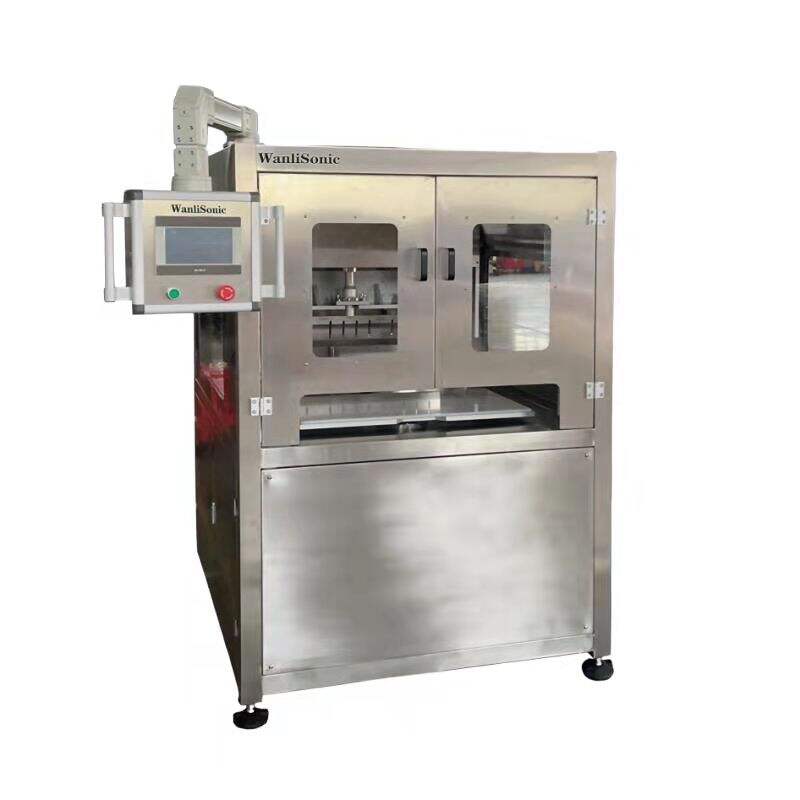
In the baking and frozen dessert industry, achieving precise slicing is essential for maintaining product quality, consistency, and production efficiency. A typical example is a frozen cheesecake with a diameter of 20 cm and a weight of 1200 grams. Dividing it evenly into 12 identical portions may appear simple, but in reality, it requires advanced technology to ensure accuracy, clean cuts, and structural integrity.
Ultrasonic cutting technology has become a preferred solution for this application, offering a modern approach that overcomes the limitations of traditional cutting methods while delivering superior results.
Challenges of Slicing Frozen Cheesecake
Frozen cheesecakes present unique physical characteristics. At temperatures between -18°C and -25°C, the cake becomes firm and slightly brittle. The internal composition—rich in fats and proteins—forms a dense structure due to freezing, making it resistant to conventional cutting tools.
Traditional blades often encounter several issues:
- High cutting resistance requiring excessive force
- Cracking along edges or crumbling at the base
- Rough surfaces with crumbs or uneven textures
- Heat transfer from the blade causing localized thawing
- Inconsistent portion sizes, especially in angular cuts
These challenges become even more significant when slicing into equal sectors, where precise angle control is critical.
The Principle of Ultrasonic Cutting
Ultrasonic cutting technology operates through high-frequency vibration, typically in the range of 20,000 to 40,000 cycles per second. The cutting blade oscillates at a microscopic amplitude, generating concentrated energy at the contact point.
Instead of compressing or tearing the product, the vibrating blade reduces internal resistance and allows for smooth penetration. This process can be described as micro-separation, where the material is gently divided rather than mechanically forced apart.
For frozen cheesecakes, this results in:
- Smooth, mirror-like cutting surfaces
- No structural deformation
- Minimal crumbs or product loss
- Reduced adhesion to the blade
The technology ensures that even dense, frozen products can be processed efficiently while maintaining their original quality.
Dividing a 20 cm Cheesecake into 12 Equal Portions
To evenly divide a 20 cm, 1200 g cheesecake into 12 slices, each portion must have a central angle of 30 degrees. Achieving this level of precision requires a coordinated system combining mechanical positioning and automated control.
The typical process includes:
1. Accurate Positioning
The frozen cheesecake is placed on a rotating platform and securely fixed to prevent movement during cutting.
2. Radial Cutting Motion
The ultrasonic blade is mounted vertically and moves from the outer edge toward the center of the cake.
3. Controlled Rotation
After each cut, the platform rotates precisely 30 degrees, ensuring consistent spacing between slices.
4. Continuous Cutting Operation
The process repeats until all 12 cuts are completed. Thanks to ultrasonic technology, the entire cycle can be finished within seconds without interruptions.
Because the blade experiences minimal resistance and does not require frequent cleaning, the operation remains stable and efficient. Each slice is clearly defined, and the overall shape of the cake is preserved.
Key Advantages of Ultrasonic Cheesecake Slicing
1. High Precision and Consistency
Ultrasonic systems can achieve extremely accurate angular cuts, with minimal deviation between slices. This ensures uniform portion sizes, which is essential for standardized packaging and pricing.
2. Superior Surface Quality
The cutting surface is smooth and clean, enhancing the visual appeal of the product. A cleaner cut also reduces exposure to air, helping maintain freshness.
3. Reduced Waste
Minimal crumbling and clean separation lead to higher material utilization, reducing production losses.
4. High Efficiency
A complete slicing cycle typically takes between 30 and 60 seconds, making it suitable for medium to large-scale production environments.
5. Hygienic Operation
Ultrasonic cutting does not require lubrication, and the blade can be easily removed for cleaning. This supports compliance with strict food safety standards.
6. Adaptability to Frozen Products
Unlike traditional methods, ultrasonic cutting performs consistently across different temperatures, making it ideal for frozen desserts.
Applications in Modern Food Production
Ultrasonic cheesecake slicing technology is widely used in:
- Industrial bakeries
- Frozen dessert manufacturing facilities
- Central kitchens
- Automated food processing lines
It is particularly valuable for products that require both precise portioning and high-quality presentation.
About Wanlisonic
Wanlisonic specializes in advanced ultrasonic cutting solutions for the food processing industry. The company provides a wide range of equipment designed for slicing and portioning products such as cheesecakes, layer cakes, sandwiches, and cheese blocks.
Wanlisonic offers both standalone machines and fully automated inline systems, supporting production capacities from small-scale bakeries to large industrial operations. Its equipment is designed to deliver high precision, efficiency, and hygiene, helping manufacturers improve productivity and product quality.
With continuous innovation and a focus on practical performance, Wanlisonic has become a trusted partner for businesses seeking reliable ultrasonic cutting solutions.
Conclusion
Precision slicing of frozen cheesecake requires more than just sharp blades—it demands advanced technology capable of handling the unique challenges of frozen products. Ultrasonic cutting provides a highly effective solution, enabling clean, accurate, and efficient portioning without compromising product quality.
For a 20 cm, cheesecake divided into 12 equal slices, ultrasonic technology ensures consistent results, minimal waste, and excellent presentation. As the food industry continues to evolve toward automation and higher standards, ultrasonic cutting stands out as a key tool for modern dessert processing.